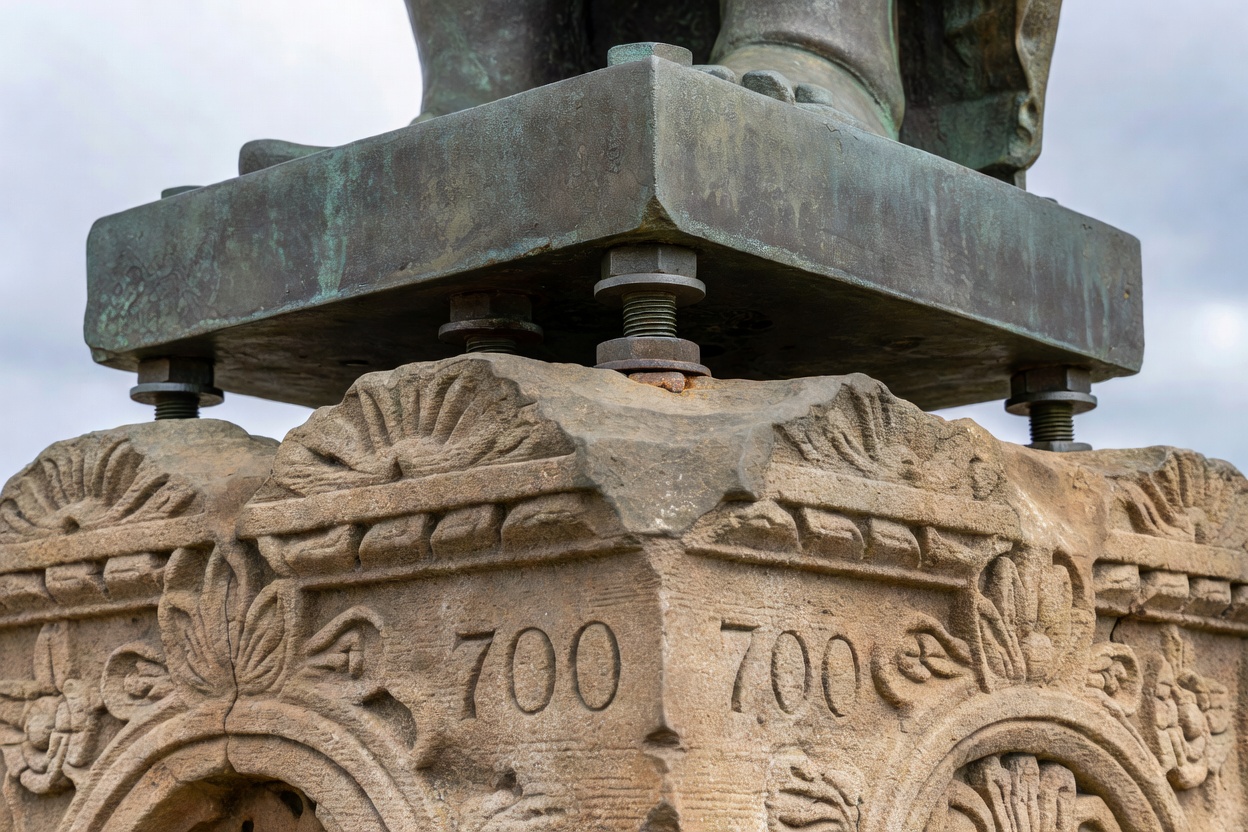
Carved Stone: Porosity, Salinity, and Structural Loss
Unlike impermeable polished granite, historical European statuary frequently utilizes sedimentary rocks such as Bath stone, Caen limestone, or fine-grained sandstones. These stones possess high inter-granular porosity, making them highly breathable but also vulnerable to soluble salts and frost wedging.
When salts (such as chlorides from winter de-icing salts or nitrates from urban soil damp) dissolve in moisture, they move through the capillary network of the stone. During dry, windy spells, water evaporates at the surface, leaving salts behind. If evaporation occurs just below the stone surface (sub-florescence), the expanding salt crystals exert pressure exceeding the tensile strength of the stone, causing the stone skin to crumble into sand-like grains.
Cast Bronze: The Anatomy of Atmospheric Degradation
Statuary bronze is an alloy primarily composed of copper and tin, often with small additions of zinc and lead to improve casting fluidity. In clean outdoor conditions, copper naturally reacts with air to form cuprite (cuprous oxide), followed by stable mineral crusts like brochantite (basic copper sulfate). This is the familiar, velvety green or brown patina that protects the metal.
However, when bronze is exposed to airborne chlorides—common in coastal cities or near salted urban transit corridors—the reaction shifts. Moisture and chlorides penetrate the patina to form cuprous chloride. When exposed to oxygen and moisture, this triggers a cyclical, autocatalytic degradation known as "bronze disease" (basic copper chloride), appearing as powdery, pale green pustules that actively pit and pit the metal core.
Material Differences at a Glance
| Dimension | Carved Stone (Limestone/Sandstone) | Cast Statuary Bronze |
|---|---|---|
| Primary Risk Factor | Freeze-thaw expansion, salt crystallization, atmospheric acid rain. | Active pitting chloride attack, galvanic corrosion from iron armatures. |
| Moisture Movement | High capillary intake and dynamic vapor breathing. | Impermeable surface; moisture collects in interior casting voids. |
| Stabilization Goal | Desalination, breathable consolidation, lime-based repointing. | Chloride inhibition (BTA or newer green chelators), wax encapsulation. |
| Incompatible Interventions | Impermeable polymeric coatings (silicones, epoxy paints). | Aggressive mechanical sandblasting or acidic pickling washes. |
Treating the Armature: The Hidden Vulnerability
Large figurative bronze statues are rarely cast as a single solid piece. They are hollow shells held together by internal iron armatures, tie-rods, and pins. In 19th-century installations, molten lead was frequently poured around iron dowels to anchor the bronze to stone plinths.
Over a century of temperature fluctuations, condensation collects inside the cold bronze interior. When the original weep-holes at the base clog with debris, water pools inside the feet of the statue. The iron armature rusts severely. Because rusting iron undergoes massive volumetric expansion, it literally shatters the bronze ankles or jacks open the stone joints beneath. Modern conservation focuses intensely on inspecting, draining, and venting these internal cavities.
The Danger of Waterproof Polymeric Sealants
It is tempting to seal old stonework with modern acrylic or silicone sealers to "keep water out." In conservation practice, this is strictly avoided. Moisture inevitably enters from ground damp or hairline fractures. Once an impermeable barrier is on the surface, moisture cannot evaporate; it concentrates behind the plastic film, freezing in winter and causing huge slabs of stone carving to shear off cleanly.
Reversible Consolidation and Mortar Matching
When stone carvings begin to powder (sanding), consolidants such as ethyl silicates may be considered. Ethyl silicate deposits amorphous silica within the stone's pore structure, recreating mineral cohesion without blocking moisture vapor transmission.
Similarly, mortar joints between monument stones must never be filled with Portland cement. Portland cement is too hard, contains soluble salts, and prevents vapor escape. Instead, conservators use natural hydraulic lime (NHL) or slaked lime putty mortars blended with aggregates that match the original color, texture, and sacrificial softness of the surrounding historic masonry.
Key Priorities in Stone Care
- Maintain permeable lime-based joints to release moisture
- Clear organic debris from carved water-shedding features
- Monitor for exfoliating crusts and salt bloom cycles
- Conduct deep desalination on stained plinth stones
Key Priorities in Bronze Care
- Clear and maintain base drainage weeping holes
- Identify and treat active pale-green chloride outbreaks
- Isolate dissimilar metals to eliminate galvanic corrosion
- Maintain flexible, breathable wax protective coats