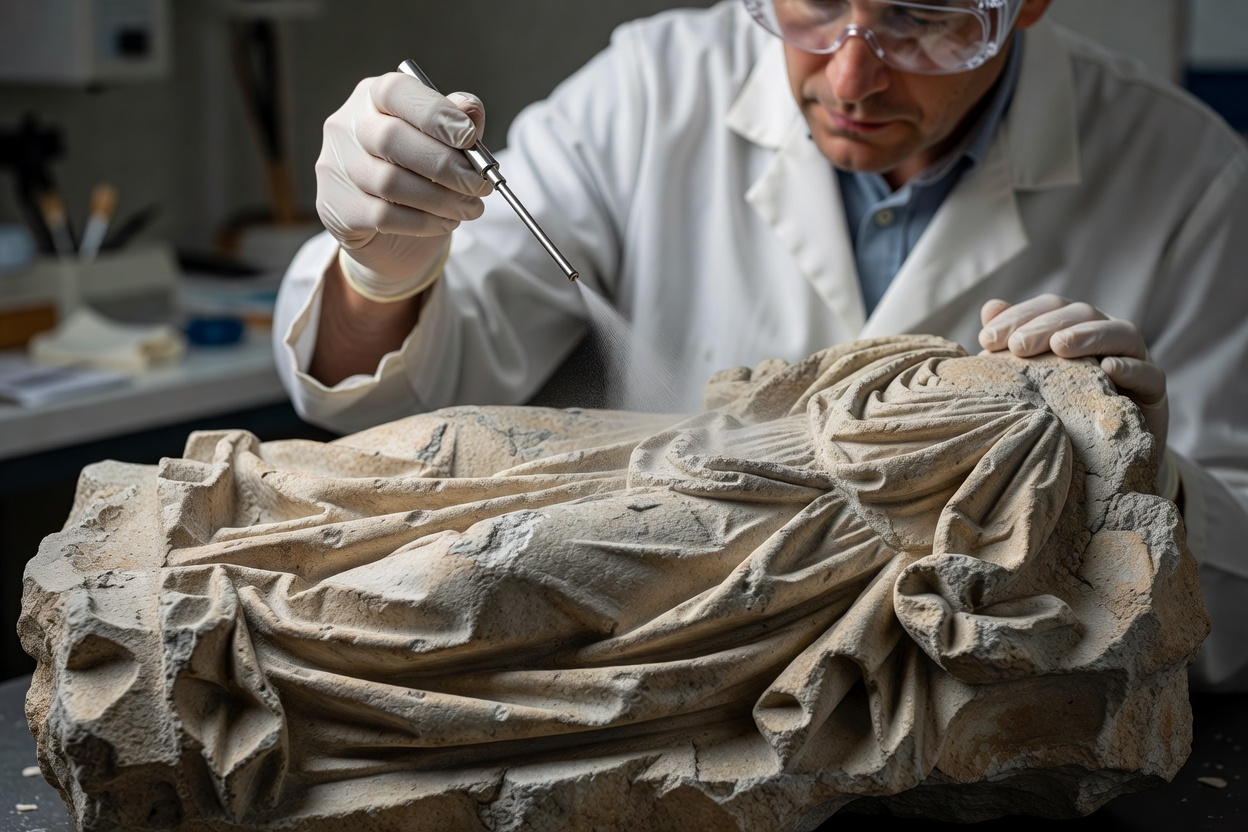
The Philosophy of Minimal Cleaning Intervention
When a bronze or marble monument looks dark and neglected in a public square, the instinct of municipal maintenance crews is often to deploy commercial pressure washers or chemical detergents. In conservation practice, this approach is disastrous. High water pressures peel away friable surface flakes, blast loose delicate historic mortar joints, and drive moisture deep into the monument's core where winter frost will split the substrate from within.
Cleaning should always start with the gentlest possible method and escalate only when diagnostics prove a deposit is actively degrading the underlying sculpture. Our cleaning protocols separate harmless atmospheric toning from destructive deposits such as calcium sulfate crusts, acidic soot, and nitrogenous pigeon guano.
Understanding Different Surface Crusts and Soot
Urban air contains sulfur dioxide and particulate matter from vehicle exhausts and industrial combustion. When sulfur dioxide combines with rain on calcareous stones like limestone or Carrara marble, the calcium carbonate converts into calcium sulfate dihydrate (gypsum). This gypsum binds carbon soot into a hard, brittle black crust.
In rain-sheltered recesses—such as under an orator's chin, the folds of carved cloaks, or deep pediments—the crust thickens because natural rainwater cannot rinse it away. As this crust expands, it exerts shear stress on the softer stone beneath, eventually causing entire carved features to exfoliate. Cleaning these specific zones prevents structural loss.
Common Cleaning Methods: A Cautious Comparison
Every cleaning method brings distinct advantages and physical risks. The choice depends on substrate durability, local atmospheric humidity, and prior treatments:
| Technique | Mechanism | Best Suited For | Primary Limitation |
|---|---|---|---|
| Intermittent Nebulization | Ultra-fine atomized water pulses soften crusts via capillary action. | Limestone, dolomitic stone, fragile historic plaster. | Requires large quantities of clean run-off capture; slow process. |
| Chemical Poulticing | Absorbent clays (sepiolite or attapulgite) draw salts and dirt outwards. | Deep grease stains, copper salt bleed into light stone bases. | Must be carefully sealed and neutralized to prevent chemical residue. |
| Precision Micro-Air Abrasion | Low-pressure soft media (crushed walnut shell or calcium carbonate). | Heavy iron corrosion on structural armature junctions. | Operator-dependent; risk of abrasion if applied to soft patina. |
| Dry Sponge Remediation | Vulcanized natural rubber sponges collect surface soot mechanically. | Indoor or sheltered bronze reliefs, fragile terracotta. | Ineffective against hardened mineralized gypsum crusts. |
Pre-Cleaning Assessment and Test Patches
We never clean an entire public sculpture without first carrying out localized discreet test patches. Typically conducted on an unobtrusive rear segment of the monument plinth, these test squares allow conservators to evaluate:
- The minimum water contact time required to plasticize airborne grease;
- Whether the stone exhibits hidden subsurface fissures that could draw cleaning solutions inward;
- How the surrounding metal joints, bronze dowels, and lead caulkings react to moisture exposure;
- The chromatic contrast between cleaned areas and surviving original patina.
What to Know Before Approaching Public Sculpture Cleaning
Cleaning is non-reversible. Once an original tool mark or natural historic patina layer is stripped by over-zealous cleaning, it cannot be replaced by synthetic means. Municipal tenders should specify conservator-supervised methods adhering to recognized international standards rather than generic commercial jet-washing contracts.
Safe Biological Growth Removal
Lichens, mosses, and cyanobacteria readily colonize outdoor stone carvings. While lichens can look picturesque, their hyphae produce oxalic and carbonic acids that chemically etch calcium minerals. Furthermore, their rhizines anchor deep within stone micropores.
Ripping dried moss off a dry sculpture pulls out chunks of historic stone. Instead, biocides formulated specifically for cultural heritage—such as quaternary ammonium compounds or low-toxicity biocidal washes—are applied to gently devitalize the growth. Once desiccated, the dead biological matter releases freely with soft bristle brushes and gentle rinsing, sparing the monument fabric from physical trauma.
Good For
- Removing soot that traps acidic air pollutants
- Devitalizing root structures of moss and lichen colonies
- Preventing moisture accumulation behind black gypsum shells
- Restoring legible architectural silhouettes to public spaces
Cautionary Points
- Never use domestic bleach, ammonia, or muriatic acid
- Never blast with high-pressure rotary water jets
- Do not clean outdoors during freezing temperatures
- Always ensure contaminated run-off water is safely contained