Why Assumptions Fail in Monument Care
To the casual observer passing through a civic square, a bronze statue may look entirely intact except for a greenish streak down one cheek. Yet under close physical examination, that streak might reveal a hairline stress fracture, water infiltration into the bronze core, or an oxidized iron pin pushing through the bronze skin.
Conversely, a stone plinth covered in dark soot might appear structurally ruined, yet the underlying granite may be completely sound, needing only light surface poulticing. A condition assessment eliminates guesswork by delivering a clear clinical diagnosis of the sculpture's health.
Core Elements of a Formal Condition Survey
Our survey methodologies align with recognized European heritage conservation frameworks (such as ICOMOS principles and EN 16096:2012 for condition recording of built heritage). A standard assessment incorporates five complementary investigations:
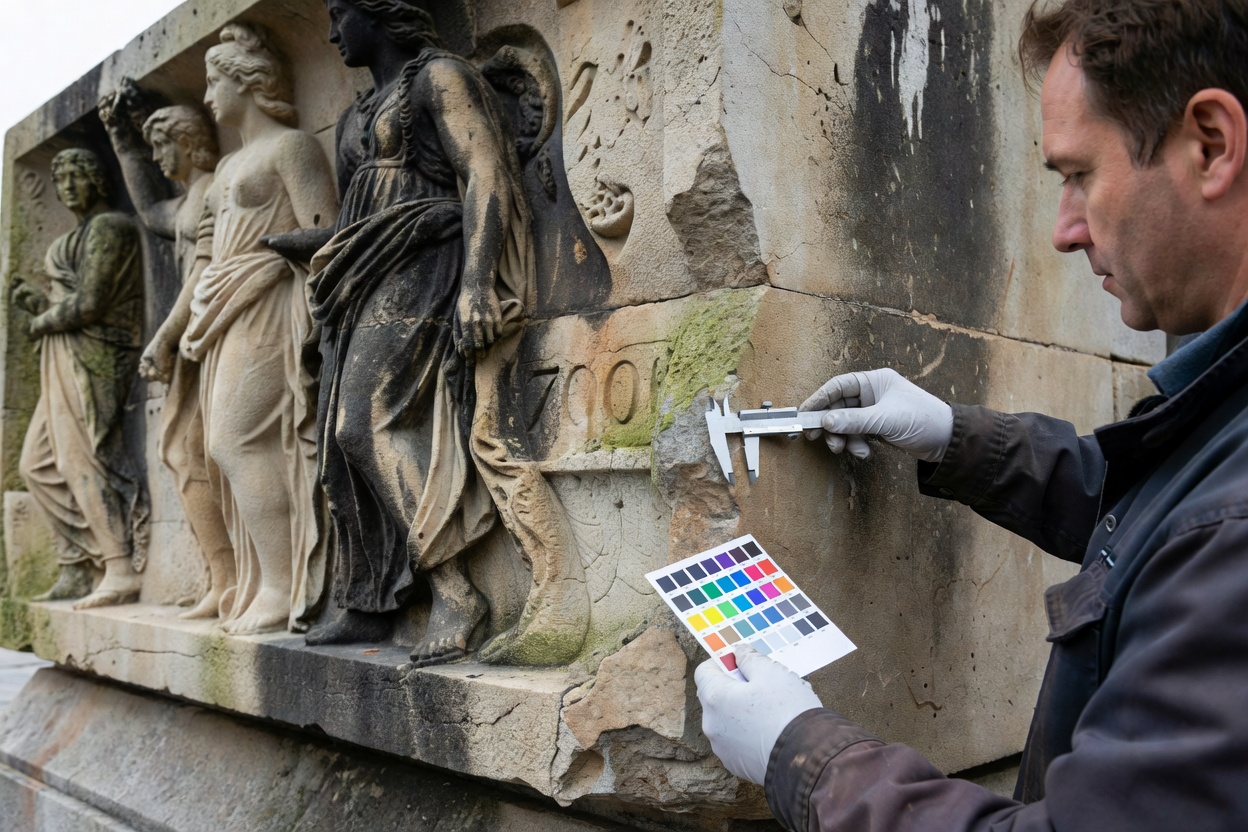
- Visual and Tactile Survey: Detailed close-range examination using magnifying loupes, raking illumination, and manual sounding with wooden mallets to identify hollow, delaminating stone areas.
- Pathology Defect Mapping: Plotting specific defects—such as exfoliation, granular disintegration, active pitting, efflorescence, biological crusting, and graffiti—onto rectified orthophotographs.
- Non-Destructive Testing (NDT): Utilizing ultrasonic pulse velocity to detect internal fissures, endoscopes to inspect hollow bronze casting interiors, and electrical conductivity meters for moisture profiles.
- Prior Previous Treatment Analysis: Identifying inappropriate historical repairs, including Portland cement repointing, synthetic mastic fills, and polyurethane varnishes that are accelerating modern decay.
- Risk Stratification (Triage): Classifying observed issues into immediate structural hazards (risk to public or monument integrity), active deterioration requiring near-term care, and cosmetic or stable historical conditions.
Defect Classification Matrix
| Observed Defect | Physical Indicator | Underlying Mechanism | Triage Urgency |
|---|---|---|---|
| Exfoliation / Spalling | Thin stone sheets detaching parallel to carving surface. | Freeze-thaw cycling behind dense atmospheric crusts. | High (Risk of irreversible feature loss) |
| Pustular Pale Green Spots | Soft, chalky light-green mounds on bronze surfaces. | Active cuprous chloride corrosion ("bronze disease"). | High (Autocatalytic metal consumption) |
| Mortar Joint Failure | Crumbled, missing, or hollow jointing between blocks. | Thermal expansion, washout of historic lime binders. | Medium (Allows ongoing rain penetration) |
| Uniform Verdigris Veil | Smooth, hard blue-green sheen over exposed bronze zones. | Stable brochantite/cuprite mineral layer. | Low / Stable (Desirable protective patina) |
Digital Photogrammetry & 3D Baseline Recording
Where complex figurative groups or fragile ornamental carvings require ongoing monitoring, we employ high-density photographic photogrammetry. By capturing hundreds of calibrated overlapping exposures from elevated mobile platforms, we generate millimeter-accurate 3D digital surface models.
These digital twins serve as an irrefutable legal and physical record. Should future vandalism, traffic collision, storm damage, or rapid environmental erosion occur, the digital model allows conservators to measure exact material loss down to fraction-of-a-millimeter tolerances.
The Role of Independent Assessment
Having an independent condition survey performed prior to tendering restoration work saves municipal budgets thousands of euros. It prevents commercial contractors from over-specifying aggressive invasive work where simple cyclical maintenance would suffice, and ensures that funds are directed to actual structural vulnerabilities.
Deliverables You Receive
- Full illustrated Condition Report with photo log
- Rectified elevation drawings with pathology hatching
- Material composition analysis (alloys and stone types)
- Triage-ranked priority action list (1-year / 5-year outlook)
When to Commission a Survey
- Prior to any scheduled civic plaza remodeling or road works
- Following unusual weather events (heavy storms, severe freezes)
- When visible fragments or powder appear at the base
- Every 5 to 7 years as part of responsible public asset governance